
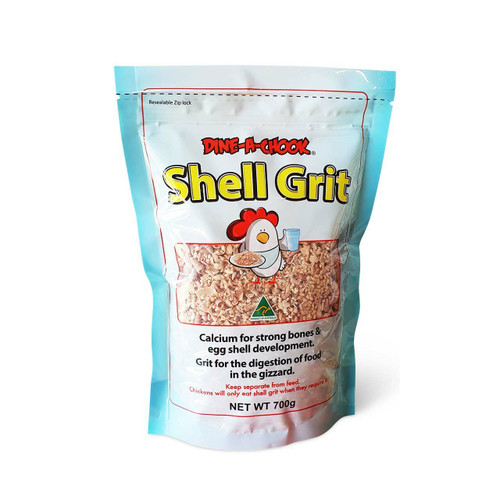



- Australian crushed seashell — 700g resealable bag
- Calcium for shell building, plus a mix of particle sizes that helps the gizzard
- Offer it free choice in its own dish — never mixed through the feed
- An average laying hen takes roughly 3–5g a day and self-regulates
- For laying birds from about 16–18 weeks. Not for chicks or growers
- Australian made and owned, since 2009
- 700g Australian crushed seashell
- Calcium for shells, grit for the gizzard
- Free choice, in its own dish
- Laying birds from 16–18 weeks
Every shell costs her about two grams of calcium
An eggshell is roughly 95% calcium carbonate, which works out at about two grams of calcium per egg — and she lays most of it down overnight, while the egg sits in the shell gland. A hen in full lay does that most days of the week, and layer feed alone does not always cover it once she is producing well.
If she cannot get calcium from her diet, she takes it from her own skeleton. Free access to shell grit is the simplest way to make sure she never has to.
Offer it free choice, in its own dish
This is the one rule that matters, and it is the mistake we see most often.
- Do not mix it through the feed. Mixed in, a hen cannot self-regulate. Some will take far more than they need and others will miss out entirely
- Put it in a separate dish or hopper where every bird can reach it
- Keep it dry and off the ground, and top it up rather than letting it get scratched through
- Replace it if it gets soiled
Left to themselves, hens are remarkably good at taking what they need. A bird coming into heavy lay will take more; one that is moulting will barely touch it.
How much does a hen actually eat?
Roughly 3 to 5 grams a day for an average laying hen, though it varies with her laying rate, her age and the rest of her diet. Older hens often take more, because they absorb calcium less efficiently than they used to.
You do not need to measure any of it. Keep the dish topped up and let them decide.
| Flock | A 700g bag lasts about |
|---|---|
| 4 hens | 6 weeks |
| 6 hens | a month |
| 10 hens | a little under 3 weeks |
Based on 4g per hen per day. Yours will vary.
When to start — and when not to
Introduce it when your pullets move onto layer feed, around 16 to 18 weeks.
Chicks and growers should not have access to it. Their kidneys are still developing and a high-calcium supplement they do not yet need can do damage. Keep it out of the brooder and out of the grower pen.
What is in the bag
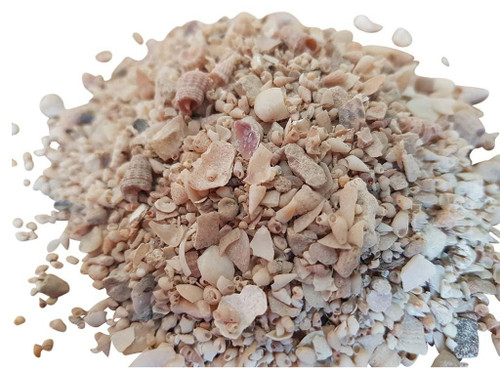
Crushed Australian seashell, graded to a mix of particle sizes and nothing else. No additives, no colouring, no filler.
The mix of sizes is deliberate. Finer particles dissolve quickly for immediate use; the coarser pieces sit in the gizzard and release calcium slowly through the night, which is when she is building the shell. It also means the grit does double duty, helping the gizzard grind feed at the same time.
Shell grit, Mineral Boost, or insoluble grit?
Three different things, and they get confused constantly.
- This shell grit is the everyday one. Calcium plus gizzard grit, in a dish, all the time. For most backyard flocks it is the only one you need
- Mineral Boost is a limestone grit coated in a vitamin and mineral premix. It is a step up for birds that are breeding, showing, racing or under stress — not a replacement for shell grit. Plenty of keepers run both
- Insoluble grit (flint or granite) does not dissolve and adds no calcium at all. It is purely a grinding aid for fully confined birds with no access to soil or coarse sand. We do not stock one
If you are only going to have one thing in the coop, make it the shell grit.
What people usually add to the order
- Dried Mealworms — the most common thing bought alongside grit, by a distance
- Apple Cider Vinegar with Garlic — a splash in the drinker
- 25ml Mega Mineral — trace minerals that support shell strength and feather condition alongside the calcium
- Shell Grit Station Bundle — a small feeder set up as a dedicated grit dispenser, with two bags included
Specifications
| Size | 700g resealable bag |
| Contents | Crushed seashell, graded. Nothing added |
| Origin | Australian |
| Suitable for | Laying hens, ducks and other laying poultry from 16–18 weeks |
| Not suitable for | Chicks and growers |
| How to offer | Free choice, in a separate dish. Never mixed through feed |
| Storage | Cool and dry, sealed between top-ups |
Product Specifications
- Size:
- 700g
Frequently Asked Questions
The questions people actually search for about shell grit.
How much shell grit do my chickens need?
Offer it free choice and let them regulate it. An average laying hen takes roughly 3 to 5 grams a day, but it varies with her laying rate, her age and the rest of her diet. You do not need to measure it out — just keep the dish topped up.
Can I mix it in with their feed?
No. This is the one thing to get right. Mixed through feed, a hen cannot self-regulate — some birds take far more calcium than they need and others miss out. Always offer it in a separate dish where every bird can reach it.
When should I start giving it, and can chicks have it?
Start when your pullets move onto layer feed, around 16 to 18 weeks. Chicks and growers should not have access to it. Their kidneys are still developing, and excess calcium they do not yet need can cause damage. Keep it out of the brooder.
How long does a 700g bag last?
At around 4 grams per hen per day, roughly six weeks for four hens, about a month for six, and a little under three weeks for ten. Yours will vary — birds in heavy lay take noticeably more.
Is shell grit the same as oyster shell?
They do the same job. Shell grit is crushed seashell with a mix of particle sizes, so it works as a digestive grit as well as a calcium source. Crushed oyster shell is typically coarser. Either works — the important part is offering it free choice, separate from feed.
Do my chickens still need insoluble grit as well?
Insoluble grit — flint or granite — does not dissolve and adds no calcium. It is purely a grinding aid. Birds with access to soil, gravel or coarse sand generally pick up what they need themselves. Fully confined birds on a hard floor may benefit from a dedicated insoluble grit. We do not stock one, so if that is your situation you would need to source it elsewhere.
What is the difference between this and Mineral Boost?
Shell grit is crushed seashell — calcium and gizzard grit, the everyday one. Mineral Boost is a limestone grit coated in a vitamin and mineral premix, aimed at birds that are breeding, showing, racing or under stress. They are complements rather than alternatives — plenty of keepers run both. If you are only having one, have the shell grit.
Can I use crushed eggshells instead?
You can supplement with them, but they should not be your only source. Eggshells dissolve faster than shell grit, so less calcium is available overnight when the shell is being formed. If you do feed them back, bake them first at 180°C for ten minutes and crush them finely.
My hens' eggshells are thin. Will this help?
It is the first thing to check. If they have not had free access to calcium, adding shell grit often supports an improvement in shell quality within a week or two. If shells are still thin after that, look at her age, heat stress, and whether anything else in the diet is competing — and speak to a vet if a bird seems unwell.
What size grit is this, and does size matter?
It is graded to a mix of particle sizes, sized for adult laying birds. The mix is deliberate — finer particles dissolve quickly for immediate use, coarser pieces sit in the gizzard and release calcium slowly overnight, which is when she needs it most.
Is it Australian?
Yes. Australian crushed seashell, nothing added. Dine-A-Chook is an Australian family business and we have been supplying backyard keepers since 2009.
Not sure what your flock needs? Get in touch — we answer our own emails.