Types of Chicken Feeders: How to Choose the Right One for Your Flock
A chicken feeder has four jobs: keep the feed dry, keep it clean, stop the chooks flicking it onto the ground, and leave nothing lying around for rats and pest birds. Most feeders sold in Australia do one or two of those jobs. This guide goes through the main types, what to check before you buy, and how to set a feeder up for your flock, whether that is three hens in a suburban coop or sixty on a paddock.
We make feeders, so we have a view. We have also spent 17 years answering the phone to chicken keepers, and most of the calls start the same way: the chooks are scooping feed out onto the ground, the feed went clumpy in the rain, or the wild birds and the rats are eating better than the hens. This is what those calls have taught us.
Short answer
- Choose a feeder with an enclosed hopper and a covered feeding opening, so the feed stays dry and below the lip where the hens cannot flick it out.
- Mount it off the ground at the height of your smallest hen's neck. A coop wall, mesh, a timber post or a star picket all work.
- Allow one feeder for every six to eight hens and spread them around the run. Chooks graze through the day; they do not all eat at once.
- If you already have rats or pest birds, deal with them first. No feeder clears an existing problem.
- Buy something made for Australian sun and rain, with a warranty behind it.
Types of chicken feeders: the five main designs
Most feeders sold in Australia fall into one of five groups. Four of the five are gravity-fed, which just means the feed moves down as the chooks eat; only an open trough is not. Most feeders sold as "automatic" are simply gravity-fed. A few are genuinely automatic, with a timer that opens a lid or drops a measured feed, and some of the newer ones run on AA batteries and send an app notification when the door opens and closes.
A word on those. They can work well, and they can also breed complacency, because "automatic" starts to mean "I don't need to look". A flat battery, a stuck door or a phone that missed the notification means hens without food until somebody notices, and that can be a couple of days if you are away. We are old school on this: a feeder that feeds by gravity has nothing to fail, and whatever you choose, the daily look at the feeder is not something any gadget replaces.
1. Open trough and bell (hanging) feeders
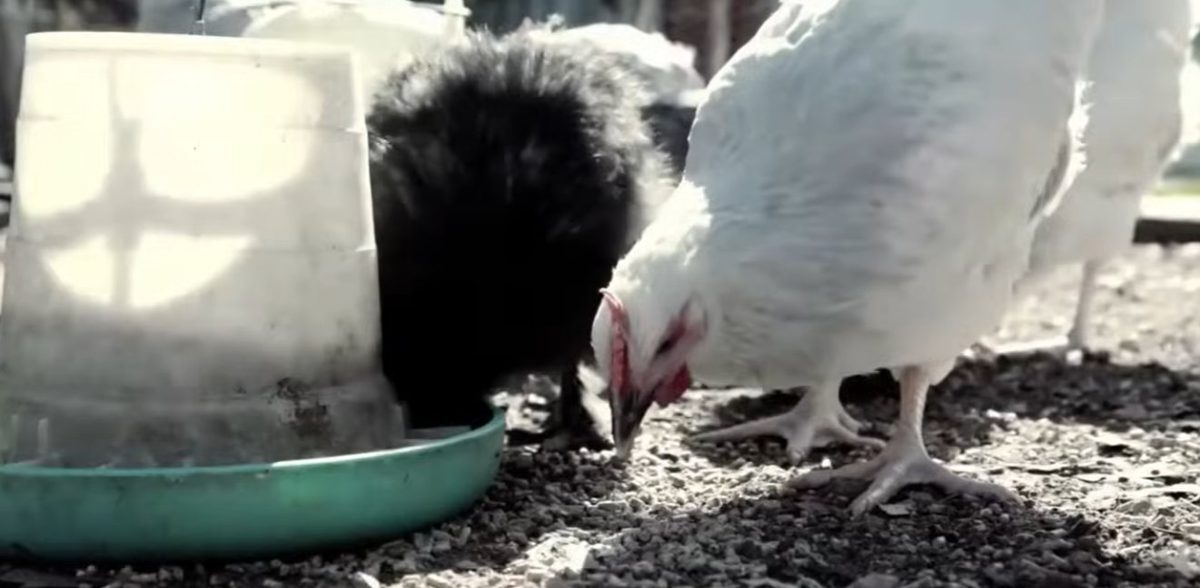
The cheapest and most common. A trough is an open tray on the ground. A bell feeder is a plastic hopper hanging from a cord with an open lip around the base. Feed is always exposed.
Hens bill sideways through the feed and flick it out, so a lot of each fill ends up on the floor, as in the photo. Rain gets in unless it is under a roof. Wild birds and rodents eat from it as easily as the hens do. A hanging bell swings when a hen bumps it, which spills more. Thin, unstabilised plastic goes chalky and brittle after a season or two in full sun. Fine for the first week with chicks; expensive to run after that.
2. Treadle (step-on) feeders
A metal box with a lid over the feed tray. The hen stands on a platform and her weight opens the lid; when she steps off, it closes. Most are galvanised or powder-coated steel, and many have an adjustable counterweight.
The lid is a moving part, and the hinge, the spring or the counterweight is usually the first thing to go. A lid that sticks open is an open trough. The tray is covered between visits but open while a hen is on the plate, so she can still bill feed out onto the ground, and driving rain gets in during the open cycle. Most trigger somewhere around 1 to 1.5 kg, which rules out bantams and young pullets, and training full-size hens takes patience; some never like the noise.
Two things customers have told us over the years that the brochures do not. Rats work in groups, and enough of them standing on the plate together will open a treadle; we have been sent the photos. And a small pest bird that flies into the open tray while a hen is feeding can be shut in when she steps off, and if the feeder is in the sun it will not survive until someone opens it again. Treadles are not the answer to rodents they are often sold as. We have written up the common problems in more detail here.
3. Tube and pipe feeders
A vertical tube of feed with an opening at the bottom, mounted to a wall or mesh. The home-made version is a length of plumbing pipe and a 90-degree elbow.
The opening at the bottom decides whether it works, and a plain elbow does not: the hens scoop feed straight out of it, rain runs in, and pest birds feed from it all day. Plumbing pipe is not made for permanent sun, so it chalks and cracks, and most home-made versions have no proper lid, so the feed gets damp from the top. They are cheap, and they cost you in feed every week.
4. Bucket and port feeders
A 10 to 20 litre bucket with a lid and one or more plastic feed ports fitted low in the side. There are a lot of these around at the moment; nearly all of them are imported plastic ports drilled into a bin.
The ports are open holes at hen height. They work for a fixed feed level but scoop out easily, the ports crack in the sun, and the bucket has to sit on the ground or a stand, which is exactly where rodents look first. The height is fixed, too: once a port is screwed into the side of a bin it cannot be moved up or down, so it has to be bang on the first time, and it cannot follow pullets as they grow. If a port cracks or the hole wears, there is no repairing it; you buy a new container. Big capacity is the selling point, but feed that sits in a bin for weeks in summer goes stale.
5. Enclosed hopper feeders with a covered feeding bay
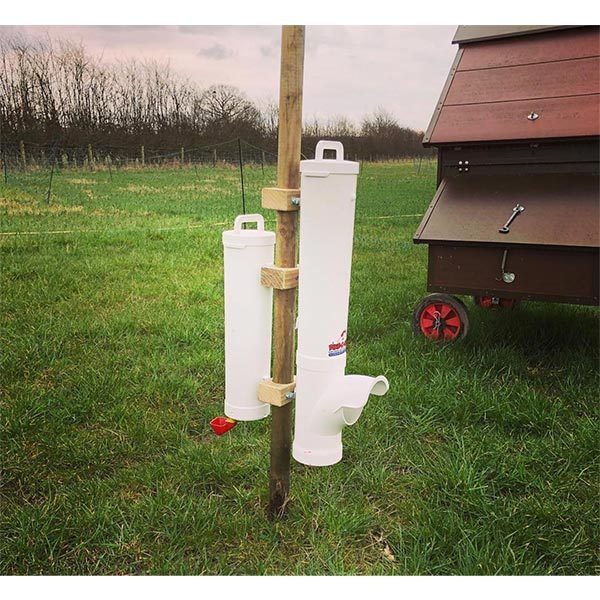
A sealed hopper, mounted off the ground, with a covered feeding bay at the bottom that the hen puts her head into. The feed sits below the lip of the bay, so far less of it ends up on the ground, and a hood over the opening keeps rain off. There are no moving parts to jam or rust, and the whole feeder lifts off its hooks to refill or to bring inside at night. This is the type we make, so read the rest of this guide knowing that.
What it costs you: more than a trough or a pipe up front. One or two birds eat at a time, which sounds like a limit and is not, for reasons covered below. Damp or very dusty feed can bridge in the hopper and needs a knock. And the feed level in the bay looks low, because it is meant to.
Chicken feeder types compared
| Type | Feed waste | Rain | Rodents and pest birds | Moving parts |
|---|---|---|---|---|
| Trough / bell | High | Exposed | Open access | None |
| Treadle | Moderate | Open while a hen feeds | Reduced while the lid closes cleanly; open once it sticks or rats work together | Lid, hinge, spring |
| Tube / pipe | Moderate to high | Open at the elbow | Open access | None |
| Bucket with ports | Moderate | Lid on top, ports open | Open access at the ports, sits on the ground | None |
| Enclosed hopper, covered bay | Low | Hooded opening | Reduced, not eliminated; lifts off to come inside at night | None |
How to choose a chicken feeder: what to check
Feed waste: can the hens flick it out?
This is the one that costs you money every week. Chickens bill sideways through feed looking for the bits they like, and anything with an open tray loses a share of every fill to the ground. One customer measured about 30% less grain after switching from an open feeder and reckoned the feeder would pay for itself in six to twelve months. Another said a feed bag now lasts twice as long. Your result depends on how much your birds were flicking out before.
Look for a feeding opening the hen has to put her head into, with the feed sitting below the lip. A narrow opening looks small, but that is what keeps the feed in. Put your finger in: if you can move the feed, the hens can reach it.
Feed type matters as much as the feeder. Whole grain and scratch mixes get picked through in every feeder, and the rejected grain is waste. A quality complete crumble or micro pellet flows well and gets eaten whole. More on that in why chicken feeders waste feed.
How many chickens can eat at once? (It matters less than you think)
We get this question a lot. The honest answer for an enclosed feeder is one or two at a time, and the honest follow-up is that it does not matter, because chooks do not eat the way most new keepers expect.
When you put a bowl of feed out for a new flock at a set time of day, they all rush it together, so it looks like they need to eat at once. That is the feeding schedule talking, not the chickens. Give them a feeder they can get to all day and the behaviour changes: they graze. One wanders over, eats for a minute, wanders off, and another takes her place. They do not arrange to meet at the feeder. That is why the rule for an enclosed feeder is one feeder for up to eight hens, and unless you have a very dominant bird it is never an issue. It is also why twenty chooks are easily fed from three feeders placed in different spots around the run: with full-time access there is never a queue.
Mounting: wall, mesh, post or star picket
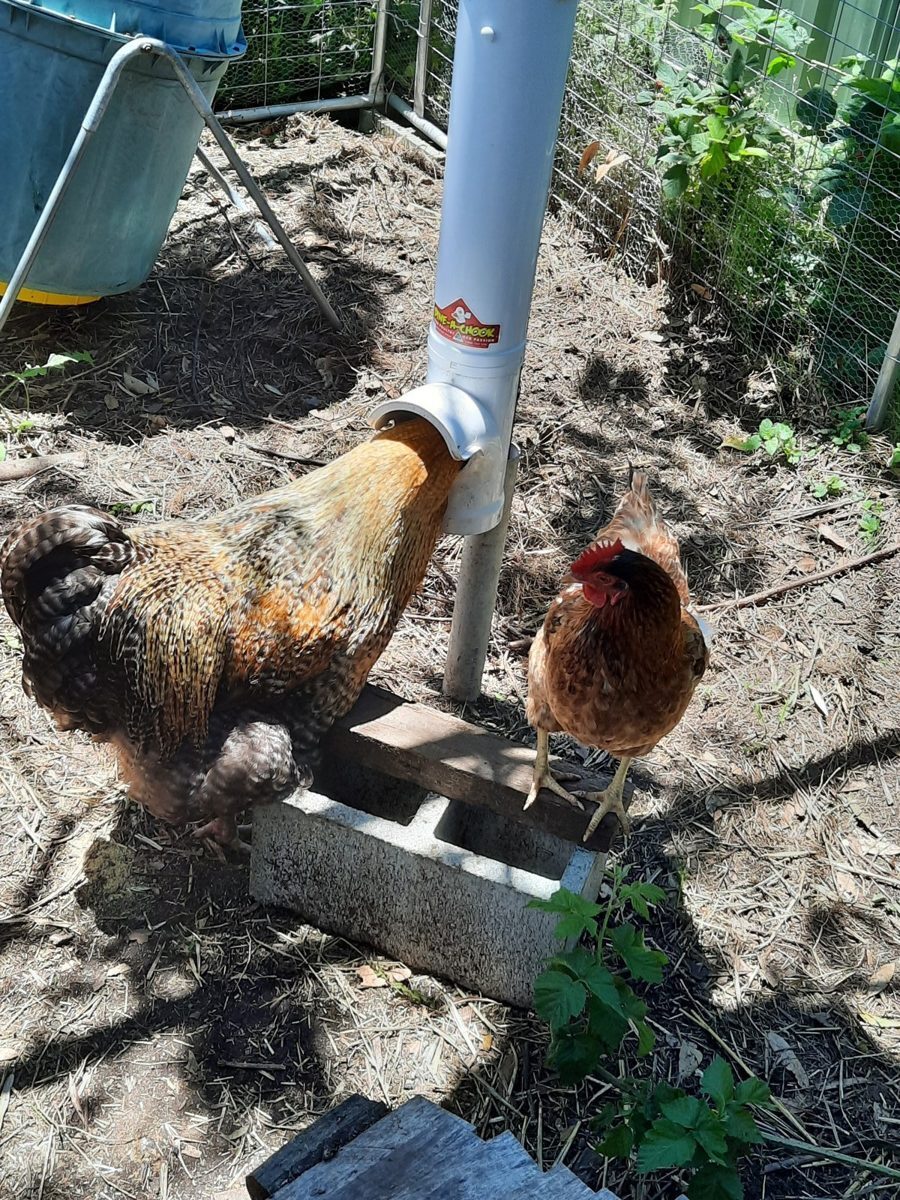
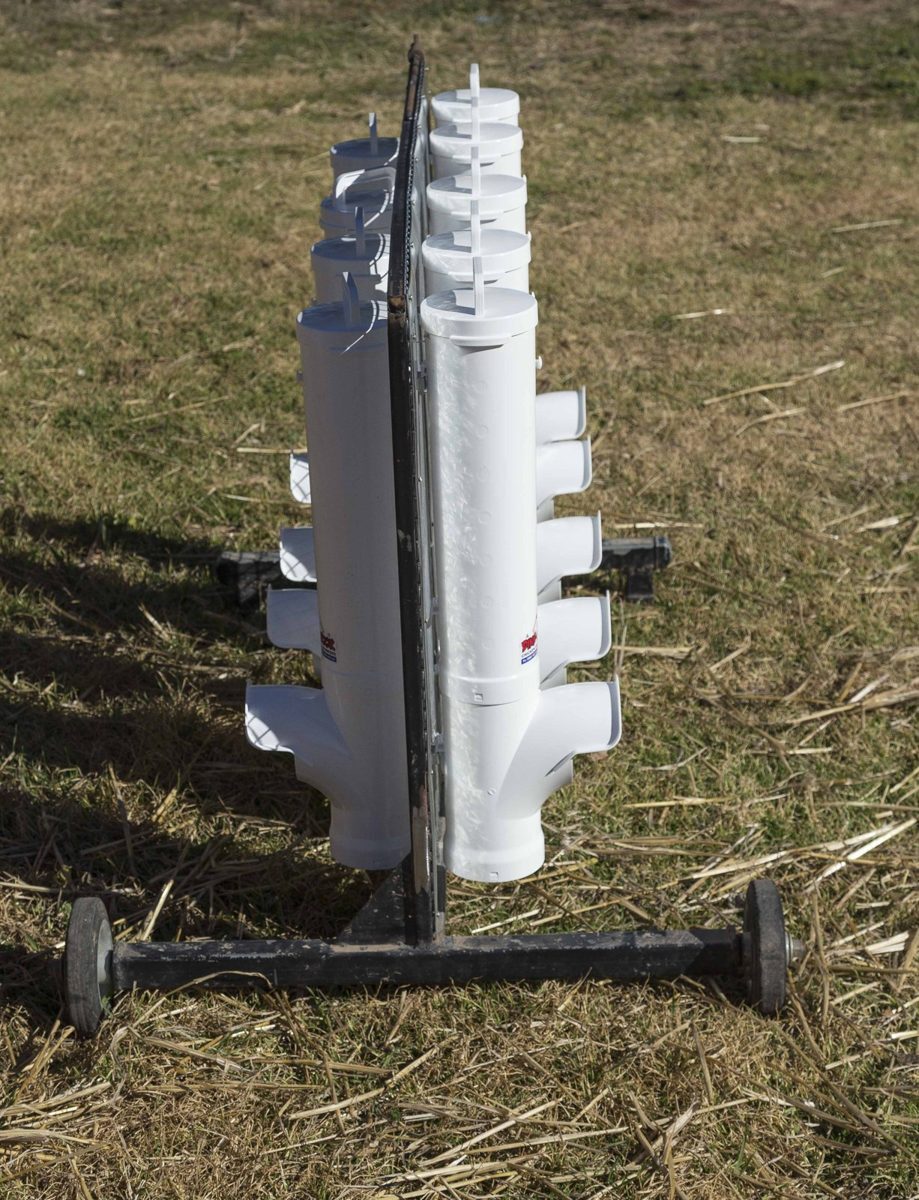
A feeder that sits on the floor collects litter and is the first thing a rat finds. A feeder that hangs swings and spills. So the feeder should be mounted, and that is easier than most people expect. You do not need a coop wall. The moulded hooks go straight onto wire mesh. In a paddock shelter, an open tractor or a portable pen, drive a timber post or a star picket into the ground beside the shelter and hook the feeder onto that. On a solid wall, timber or tin, use a bracket; we supply the brackets and screws. Customers with big flocks go a step further and build feeder trolleys: a mesh panel on wheels with five feeders down each side, which they wheel around the paddock behind the flock.
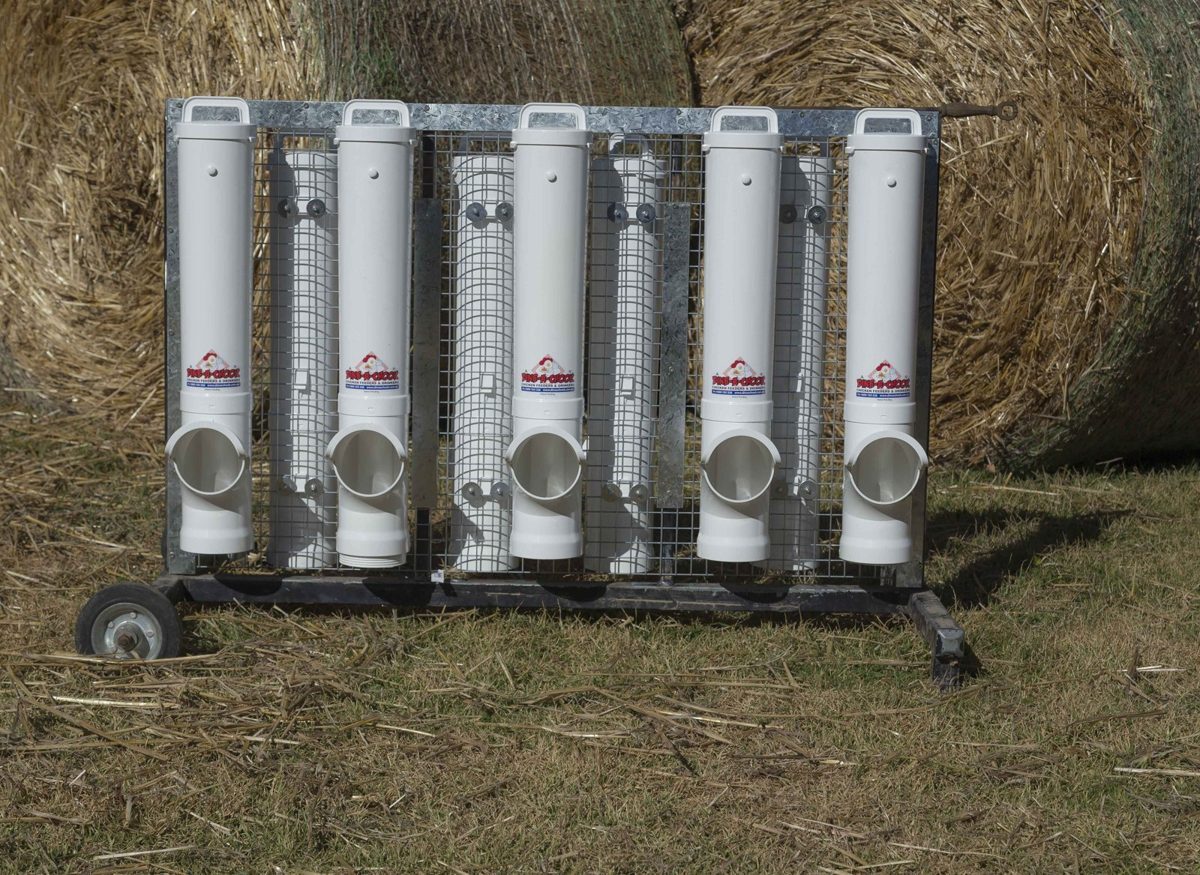
Height is the part most people get wrong. The opening should sit at the back of your smallest hen's neck when she is standing naturally, roughly 100 to 150 mm off the floor for most breeds. She should eat without stretching or crouching. Too low and she scoops; too high and the small birds miss out. In a mixed flock, two feeders at two heights solves it. Keep it in the shade so the feed stays cool. Our complete feeder guide covers mounting on mesh, timber and tin step by step.
Rain and sun
Damp feed can go mouldy in a day or two of summer humidity, and mouldy feed is a genuine health risk, so throw it out rather than stirring it through. If any part of the feeder is open to the sky, it needs a roof over it. A hood keeps ordinary rain off. Nothing keeps out rain blowing sideways in a storm, so put the feeder on the sheltered side of the coop; on ours, the worst case in a sideways downpour is damp feed at the mouth of the bay, not a flooded hopper, and it is the mouthful you throw out.
Australian sun is the other weather problem. Cheap plastic does not survive it; two or three summers and it cracks. Look for UV-stabilised plastic (ASA is the material used for outdoor gear that has to last) and ask how many summers it is expected to see. A feeder that is built to last should come with a warranty that says so.
Rodents and pest birds: what a feeder can and cannot do
No feeder on the market keeps rats out completely, including ours, and a feeder will not get rid of rodents or pest birds that are already established. Once rats have found food in the coop they will chew through a lot to keep getting it. Pest birds that have learned the coop is a free feed will keep turning up for as long as there is feed on the ground.
What a good feeder does is leave less spilled feed lying around the coop, and spilled feed is what draws rats and pest birds in the first place. Look for a rodent-resistant design, one that keeps feed off the ground and inside a hopper, not one that claims to keep them out. Keep the feed bags in a sealed metal bin, too; an open bag in the corner of the shed undoes everything the feeder does.
If you already have a problem, deal with the problem first. The advice we give on the phone:
- Pest birds: take away the food source for at least a week. Feed the chooks morning and afternoon and remove the feeders during the day. With no reliable food, they move on.
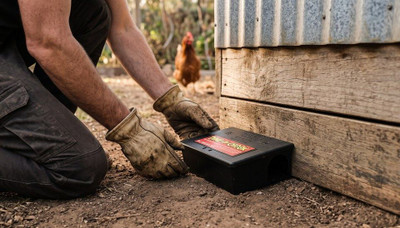
- Rodents: remove all food sources, take feeders in at night, and bait properly in a lockable station, following the label. The rules changed in 2026; here is what you are now allowed to do around a coop, and here is the full rodent plan.
Then choose a feeder that is easy to lift off its hooks and bring inside at night, which does more against rodents than any feature of the feeder itself.
Capacity: how many days between refills
A standard laying hen eats about 120 g of complete feed a day, up to 150 g for heavy breeds or in cold weather, and less for bantams (Agriculture Victoria has a good page on feeding backyard poultry). Plan refills at 150 g a hen and you will never run short: six hens for five days is about 4.5 kg. A feeder that holds three weeks of feed sounds handy, but feed that sits in a hopper for weeks in summer goes stale. Two or three feeders you fill weekly beat one you fill monthly.
From our own range, as an example: the 3.5 litre feeder comfortably feeds 4 hens for about 4 days, and the 4.7 litre feeds 6 hens for about 4 days. These are rounded guides; actual days depend on breed, feed density and how much the birds free-range. If you go away for weekends, an extra feeder is simpler than a bigger one.
Cleaning and durability
Any feeder that lets moisture in needs cleaning out, because damp feed in a corner goes mouldy and draws ants. A feeder that keeps the feed dry should not need it at all. In 17 years we have not cleaned ours; moisture does not get in. If you ever want to, remove the base, hose it out and let it dry before you refill. The other thing to check is what can break. The hinge, the spring or a glued joint is usually the first thing to go on any feeder, so fewer parts is a fair thing to prefer.
Where it is made
Very little poultry equipment sold in Australia is made here. Most of it is imported, and some of what is sold as Australian made is assembled here from parts moulded overseas. It matters for two reasons: plastic specified for Australian UV rather than a generic export market, and someone local to answer the phone and honour the warranty. Ask where the parts are moulded, not just where the box was packed. Our feeders are injection moulded in Brisbane and hand assembled in our Townsville warehouse, with no imported components, and we are one of very few poultry equipment makers in the country who can say that.
Setting up for your flock size
- Three to six hens in a backyard coop: one enclosed feeder on the wall or mesh covers it. If the coop is low, the 3.5 litre size suits chicken tractors and coops you cannot stand up in.
- Six to twelve hens: two feeders, so nobody gets bullied off the food, at two heights if the breeds vary.
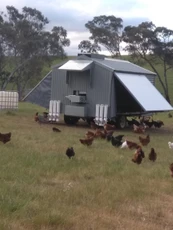
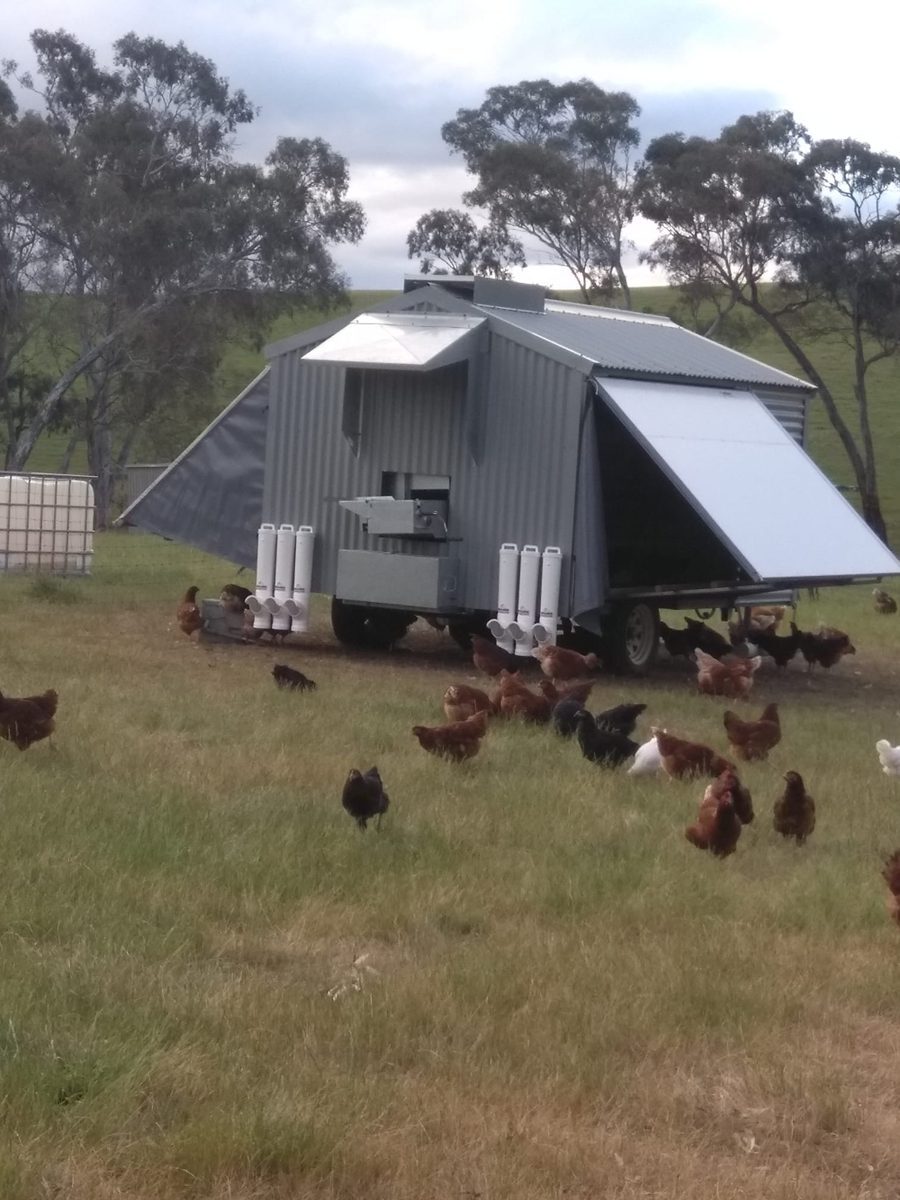
- Twenty or more: one feeder for every six to eight birds, spread around the run rather than side by side. Three feeders in three spots handle twenty chooks easily. For larger flocks, customers mount five to ten on a mesh trolley or along the side of a mobile coop, as in the photos.
- Paddock, open tractor or portable pen, no wall: a timber post or a star picket driven in beside the shelter, or a bracket on the tractor frame.
- Chicks: a shallow tray of crumble in the brooder for the first weeks, then onto the feeder as soon as they can reach the bay. A treat in the opening speeds the switch.
- Going away for a few days: count the days at 150 g a hen and add a spare feeder rather than over-filling. Most chooks take to a new feeder within minutes, some within a few days, so change feeders a week before you leave, not the night before.
What about drinkers?
The same logic applies to water. An open bowl or fount has every litre exposed to dirt, droppings and sun, and goes green within days in summer. With a cup drinker, the only water in the open is the mouthful sitting in the small cup; the rest stays sealed in the canister or drum behind it and refills the cup as the birds drink. A drum system runs for a week or more between fills. Whatever holds the water should be opaque, because a clear container in the sun grows algae. Our drinker comparison goes through the types, and the automatic chicken waterers page has the drum and cup options.
Where the Dine-A-Chook feeder fits
Ours is an enclosed hopper feeder with a covered feeding bay. It was designed in Townsville after a lot of hours filming hens eating, and the design has not changed much since 2009: a rain hood and gutter over the opening, fixed paddles in the bay that keep the feed below the lip, moulded hooks for wall, mesh or post mounting, and a threaded lid. No moving parts to go wrong. The parts are injection moulded in Brisbane in UV-stabilised ASA and assembled by hand in Townsville, with a 3-year warranty. More than 80,000 customers have bought from us since 2009.
What it will not do: it will not clear an existing rodent problem, it will not stop rain blowing sideways in a storm, and it works better with a quality crumble or micro pellet than with whole grain. The chicken feeder range is here, and the complete guide to our feeders answers the installation and use questions in detail.
Frequently asked questions
What type of chicken feeder is right for a backyard flock?
An enclosed feeder with a covered feeding opening, mounted off the ground at neck height. It keeps the feed dry, keeps it below the lip so the hens cannot flick it out, and lifts off to come inside at night if rodents turn up. One for every six to eight hens.
How many chickens can use one feeder?
Up to eight. One or two eat at a time, but with all-day access chooks graze rather than queue, so a feeder is never the bottleneck unless one bird is very dominant. For bigger flocks, add feeders in different spots rather than a bigger feeder.
How high should a chicken feeder be, and what can I mount it on?
The opening at the back of your smallest hen's neck, about 100 to 150 mm off the floor. Wire mesh, a coop wall, a timber post or a star picket all work. The complete guide to our feeders has the step-by-step for each.
Do treadle feeders keep rodents out?
Not reliably, and no feeder does. A treadle lid is a barrier while it closes cleanly, stops being one when the hinge sticks, and rats have been photographed opening one by standing on the plate together. Rodent control is a baiting or trapping program plus removing food at night, whatever feeder you own.
Why does the feed look so low in an enclosed feeder?
Feed sitting below the lip of the opening is what stops it being flicked out. Try the finger test in the feed waste section above.
How long do chooks take to learn a new feeder?
Usually minutes, occasionally a few days. Put a few dried mealworms or some scratch in the opening on day one. One bird works it out and the rest copy her. As one customer put it: "It took a few days for the chooks to work it out, now it's fine. I filled the front section early on to give them an idea of how it works."
Should I leave feed out all day or feed twice a day?
Leave it out. Laying hens eat little and often through the day, and all-day access is what turns the feeding-time rush into calm grazing. Twice-a-day feeding is the tool you use when pest birds have moved in, not the everyday routine. The NSW Department of Primary Industries backyard poultry FAQs and the RSPCA feeding guide cover diet in more depth.
Should I take the feeder in at night?
If you have any sign of rodents, yes, until the problem is dealt with. Chickens do not eat in the dark, so they lose nothing.