The New Rat Bait Rules: How to Bait Legally Around a Chicken Coop
Most people who keep backyard chickens have no idea that Australia’s rat bait rules were rewritten this year. In March 2026, the APVMA (the national regulator for agricultural and veterinary chemicals) suspended every second-generation anticoagulant rodenticide on the market — that is nearly every supermarket and hardware-store rat bait in the country — and replaced their label instructions with a new, much stricter set of mandatory conditions.
The products can still be sold and used. But how you are allowed to use them has changed, and some of the changes matter a great deal if your rodent problem is where most chicken keepers have one: outdoors, around a coop, with birds, pets and sometimes children nearby.
Here is what changed, in plain English, and the protocol we recommend to customers who call us about rats.
What actually changed
The suspension took effect on 24 March 2026 and runs for 12 months. It covers all second-generation anticoagulant actives — including difenacoum, the active in the Ratshot blocks we stock. During the suspension, the instructions printed on the pack no longer apply wherever they conflict with the APVMA’s replacement instructions. The replacement instructions are the law, not a recommendation.
The rules now, translated for a chicken keeper
No outdoor baiting for mice. At all. Outdoor bait stations are now for rats only. If your problem is mice, bait indoors (the feed shed, the garage) or use non-toxic options like traps outdoors. This is the rule almost nobody knows.
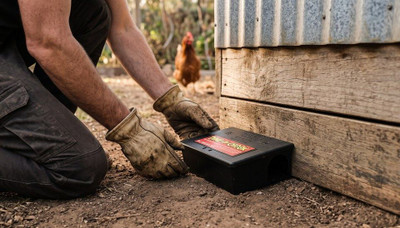
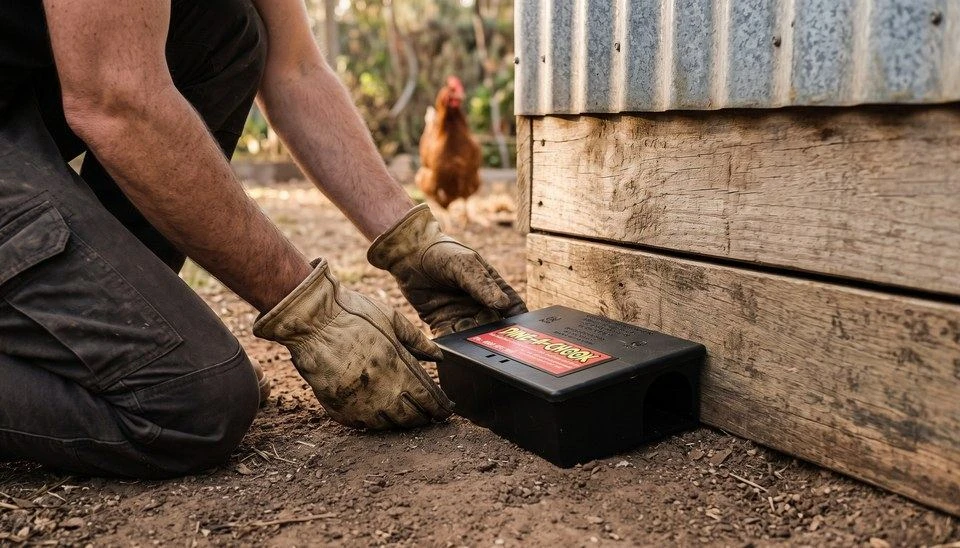
Outdoors, bait must be inside a tamper-resistant, weather-resistant bait station, secured in place. Loose bait, bait on a tray, bait tucked under a sheet of tin — all now non-compliant outdoors. The station is mandatory.
Anywhere accessible to pets, children or non-target animals needs a tamper-resistant station. A chicken run is, by definition, accessible to non-target animals. So even where you might have argued a spot was “indoors”, around a coop the station is required.
Stations go no more than 2 metres from a building. The coop wall, the feed shed, the house — fine. A fence line 20 metres out in the paddock — no longer allowed.
Never put bait straight into burrows.
Don’t bait continuously for more than 35 days without stopping to assess. If bait is still being taken after five weeks, the answer is to re-evaluate the infestation and what is feeding it — not to keep pouring bait in.
Search for and remove dead rodents every time you check the station. Wear disposable gloves for bait, stations and carcasses. Dead rodents left lying around are how owls, kookaburras, dogs and cats get secondarily poisoned.
Why we only stock the blue blocks
Long before these rules existed, we made a decision that looks a lot like them: we stock one rodenticide active, difenacoum (the blue Ratshot blocks), and we sell it with a lockable bait station. The reason is the safety margin for the animals you are not trying to poison.
Freezone (the maker of Ratshot) publishes the comparison. The numbers below are the amount of bait per kilogram of bodyweight involved in poisoning risk for non-target animals:
| Active | Typical products | Chickens | Dogs |
|---|---|---|---|
| Difenacoum (blue) | Ratshot Blue | ~1,000 g/kg | ~1,000 g/kg |
| Brodifacoum | Ratshot Red, Talon | ~90 g/kg | 5–20 g/kg |
Source: Freezone active-comparison data.
To put that in real terms: on the difenacoum numbers, a laying hen would need to eat roughly her own bodyweight in blue bait to be at risk. On a brodifacoum product, a few hundred grams. For dogs the gap is wider still — somewhere between 50 and 200 times. And because difenacoum is less acutely toxic gram for gram, the risk to a dog or a raptor that catches a poisoned rodent is lower too.
None of that makes any bait harmless, and nothing here replaces the label. It means the margin for error around a coop is far wider with the blue blocks than with the red ones — and under the new rules, margin for error is exactly what you are managing.
The protocol we give over the phone
The bait is step three, not step one. Here is the full sequence we recommend:
- Find the activity. Droppings, grease smears along walls, an ammonia smell, fresh gnawing damage. Rats can get through a gap the width of your thumb; mice, your pinky.
- Remove the food source first. This is the manufacturer’s own first step, and it is ours too. Clear spilled feed and scraps, store feed in sealed containers, and where you have a known rodent problem, take the feeders away at night. A Dine-A-Chook Feeder keeps feed high and dry, off the coop floor, which removes the buffet that attracts rodents in the first place — but no feeder evicts rats that are already fed from somewhere else. Management does that.
- Set the blue blocks in a lockable bait station, secured in place, within 2 metres of a building. Never loose. Gloves on.
- Monitor and replenish. Rapid uptake means a bigger population than you thought — keep the station stocked rather than letting it run empty. If you are still feeding bait at 35 days, stop and reassess.
- Collect and dispose of dead rodents every visit, per the label and your local council’s rules.
What you need
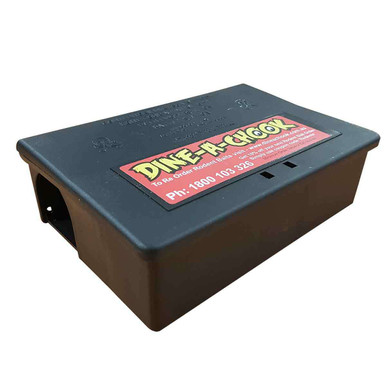
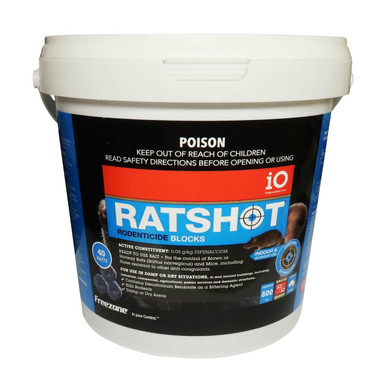
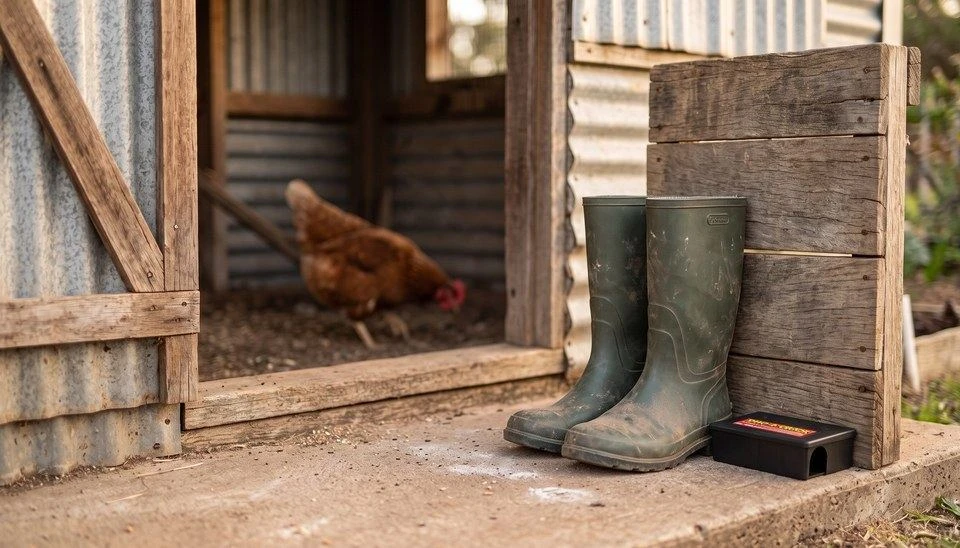
The station plus the blocks covers a normal backyard infestation with bait to spare for monitoring.
The official instructions
We keep the full mandatory conditions on their own page: the APVMA Conditions & Instructions for Use — it opens in a new tab, reads well on a phone at the coop, and prints cleanly if you want a copy in the feed shed. They are the same conditions that now govern every second-generation bait in Australia (APVMA Gazette No 5, 10 March 2026).
If you are dealing with a rodent problem that will not shift, our guide on how to get rid of rats in the chicken coop covers the coop-management side in more depth — and if you are not sure what you are dealing with, give us a call. It is the advice we give every week on the phone, and we are happy to give it.