The Best Chicken Feed for Laying Hens
Why Quality Complete Feed Matters for Laying Hens
If your hens aren't laying well, their feathers look dull after a moult, or you're going through bags of feed faster than you expected — the problem might not be your chickens. It might be what's in the bag.
After 15 years of helping backyard chicken keepers, the first question we always ask is: "What feed are you using?"
The 90% Rule
90% complete feed
A quality complete feed should make up at least 90% of your laying hen's diet.
Treats, scraps, and scratch mix are the other 10% — not the main event.
What laying hens actually need
A hen producing an egg every day or two has serious nutritional demands. Here's what the science says:
Essential for egg production, feather regrowth, and overall health. Many grain mixes only hit 12–15%.
Critical for strong shells. Cheap grain mixes often contain only 2–2.5% — half what's needed.
A, D3, E, K, all B vitamins, plus selenium, zinc, manganese. Grain alone won't provide this.
The ice cream problem
Here's how the Alabama Cooperative Extension Service puts it:
"If children are offered ice cream at every meal, they will eat it with gusto. Of course, we know that the children won't receive essential nutrients for growth from a lot of ice cream. The same applies to your birds."
Scratch grains and treats are the "ice cream" of the chicken world. Given the choice, chickens will fill up on these incomplete feeds and skip the nutrition they actually need.
Why grain mixes cause problems
Chickens will pick through to find the tasty bits — corn, sunflower seeds — and leave the rest. As far as they're concerned, the nutritious bits can go to the rats.
Even if a grain mix is labelled "complete," selective feeding means your birds aren't getting the balanced diet printed on the bag. They're getting empty calories.
Many scratch mixes contain molasses to bind ingredients. In humid weather, this causes clumping — which can block feeders and create flow issues.
The more beak activity in the feeder (picking favourites), the more feed ends up scattered. Scattered feed attracts rodents and pest birds.
What we recommend
When customers ask what feed we use and recommend, we point them to Laucke Mills. We're not affiliated with them — we just believe in quality, and they've been delivering it since 1899.
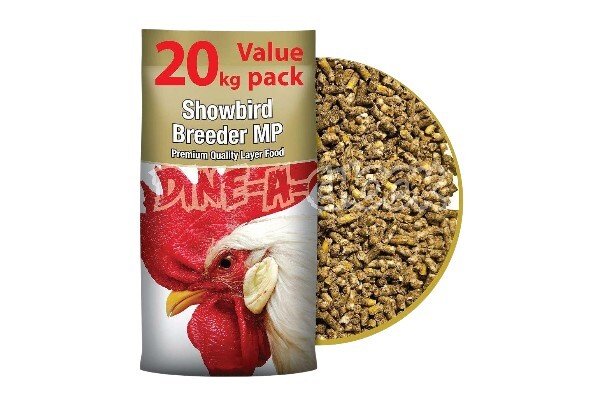
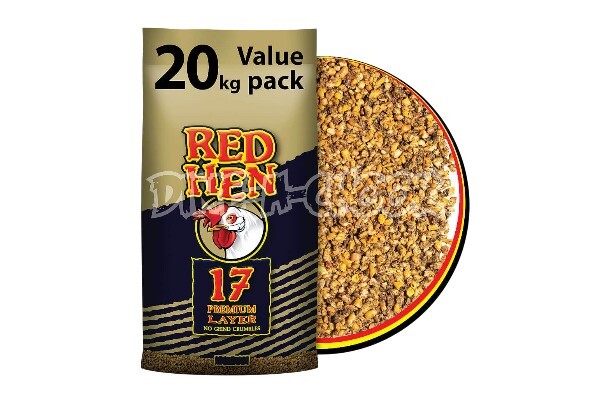
Why these feeds work perfectly in a Dine-A-Chook feeder
No molasses means no clumping in humid weather.
Uniform particles mean every bite is balanced nutrition.
Less beak activity means less feed scattered on the ground.
Two Australian family businesses
We're not paid to recommend Laucke Mills. We recommend them because we share the same values.
Friedrich Laucke arrived from Germany, ran out of money in Adelaide, and was working as a miller within weeks. When his mill exploded in 1905, he climbed onto the smoking ruins, lit a cigar, and declared he'd rebuild.
Now in their 4th and 5th generation, they're the last of Australia's founding family-owned millers. Quality and HACCP certified.
We started in a garage, cutting PVC pipes on the front lawn and hand-wrapping every feeder in cardboard offcuts from the local packaging factory. We couldn't afford to make a product that didn't work.
Now injection moulded in Brisbane and serving 50,000+ customers. The design principles haven't changed.
Two families who believe quality matters. That's why we recommend their feed.
Find Laucke Mills near you
Ready to switch to a quality complete feed? Find your nearest Laucke Mills stockist.
Find a Stockist →Supporting the foundation
Quality feed provides the foundation. But even the best commercial feed has inherent limitations — not because of the manufacturer, but because of factors beyond anyone's control.
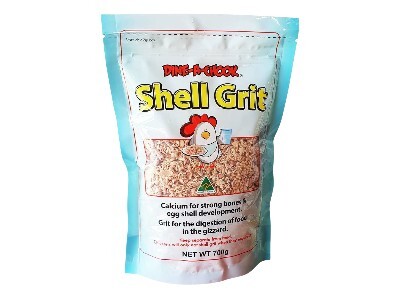
Why shell grit matters
A quality layer feed contains around 4% calcium — enough for the average hen. But hens aren't average. Heavy layers need more. Older hens need more. Hens in hot weather (when they eat less feed) need more.
Shell grit lets each hen self-regulate. She'll take what she needs — no more, no less. It also aids digestion by helping the gizzard grind food properly.
Best practice: Offer shell grit free-choice in a separate container, not mixed with feed.
Why trace minerals matter
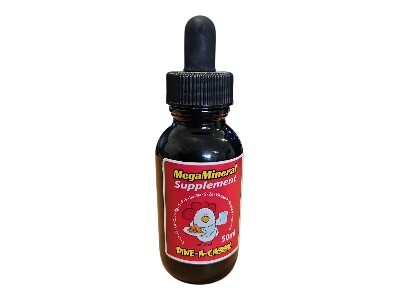
Australian soils are naturally low in trace minerals — selenium, zinc, copper, manganese. The grains in any feed can only contain what's in the soil they grew in.
Add treats, scraps, or free-range foraging (which dilute feed intake), and the gap widens. Subtle deficiencies show up as dull feathers, slow moult recovery, and shells that crack too easily.
Mega Mineral provides chelated trace minerals — bonded to amino acids for actual absorption. Just 4–5 drops per litre of drinking water.
Set up your complete nutrition system
We've put together bundles to help you support quality feed with free-choice calcium and trace minerals.
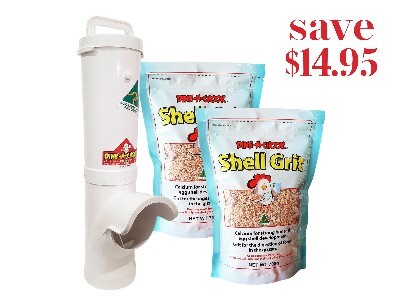
A dedicated calcium station. The Small Feeder becomes a shell grit dispenser — exactly what customers have been asking for.
• Small Chicken Feeder (3.5L)
• Shell Grit 700gm
• + FREE Shell Grit 700gm

Trace mineral support in one easy kit. The 2L Drinker becomes your dedicated mineral water station.
• 2L Drinker with Single Lubing Cup
• Mega Mineral 50ml
(3–5 months supply for 4–6 birds)

Everything you need to support quality feed — plus a free treat to get started.
• Small Chicken Feeder (3.5L)
• Shell Grit 700gm
• 2L Drinker with Single Lubing Cup
• Mega Mineral 50ml
• + FREE Mealworms 283gm
Complete feed is the foundation — but what about the fun stuff? In our next article, we'll cover which treats are actually okay, how to use scratch mix responsibly, and why the "handful of scraps" can become a problem.
Coming soon.