Shell Grit for Chickens: Why Your Hens Need It and How to Get It Right
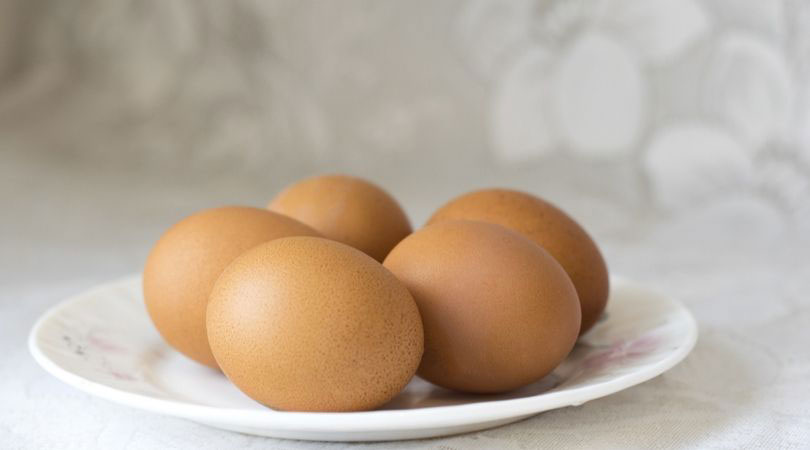
If you’ve ever cracked open an egg and noticed the shell felt paper-thin, or found a soft-shelled egg on the coop floor, your hens are telling you something. In most cases, the answer is remarkably simple: they need more calcium, and shell grit is the easiest way to provide it.
Shell grit is one of those quiet essentials of chicken keeping. It’s inexpensive, low-maintenance, and does two jobs at once — it provides the calcium your laying hens need for strong eggshells, and it helps them physically grind and digest their food. Yet it’s one of the most commonly overlooked supplements in backyard flocks.
This guide covers everything you need to know: what shell grit actually is, why chickens need it, how to offer it properly, and the mistakes that trip up even experienced keepers.
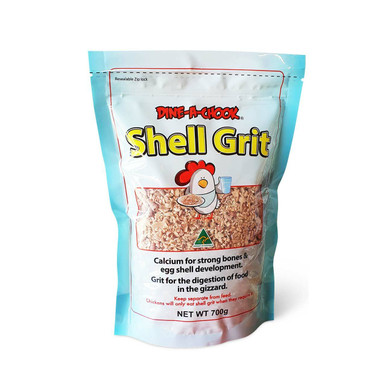
If you already know you need it, this is the bag most of our customers start with:

What is shell grit?
Shell grit is exactly what it sounds like — crushed seashells, processed into small, angular pieces. It’s made from natural marine shells (typically cockle, mussel, or oyster) and is sold specifically as a poultry supplement.
It serves two purposes in a chicken’s body:
- Calcium source: Shell grit is roughly 38% calcium carbonate. When a hen digests it, the calcium is absorbed through her gut and used to form eggshells. A single eggshell contains around 2 grams of calcium — that’s a significant daily demand for a bird laying every 25–27 hours.
- Digestive aid: Chickens don’t have teeth. They swallow food whole, and it’s ground up in the gizzard — a powerful muscular organ that works like a biological mill. The gizzard needs hard, angular material to do its job. Shell grit provides that.
Key point
Shell grit does double duty — it’s a calcium supplement AND a digestive aid. That’s why it’s preferred over pure calcium supplements for most backyard flocks.
Why do chickens need shell grit?
The calcium demand is relentless
A laying hen uses around 2 grams of calcium every time she produces an egg. Most of that calcium is deposited onto the shell during the final 15–20 hours of egg formation, with the heaviest deposition happening overnight while the hen sleeps.
A quality layer feed contains around 4% calcium, which covers the baseline requirement for an average hen. But hens aren’t average. Some lay more frequently than others. Older hens absorb calcium less efficiently. In hot weather, hens eat less feed but still need the same calcium for shell production. This is where supplemental shell grit fills the gap.
Without enough calcium, the hen pays the price
When dietary calcium isn’t sufficient, a hen’s body doesn’t just produce thinner shells — it starts pulling calcium from her own bones. This stored calcium comes from a specialised bone tissue called medullary bone, and it’s meant to be a short-term reserve, not a long-term supply.
Hens that regularly draw on medullary bone reserves can develop weakened legs, reduced mobility, and in severe cases, cage layer fatigue — even in free-range birds. It’s entirely preventable with proper calcium supplementation.
Digestion suffers without grit
Free-range chickens pick up small stones and grit naturally as they scratch around. But many backyard flocks don’t have access to enough natural grit, especially if they’re on grass, mulch, or sand. Without hard material in the gizzard, food passes through partially undigested, meaning the hen gets less nutrition from the same amount of feed.
If you’ve noticed your feed bill climbing or your hens looking a bit rundown despite good feed, poor gizzard function could be a factor. Shell grit solves both the calcium and the digestion problem in one go.
Shell grit vs oyster shell vs crushed eggshells
This is one of the most common questions in backyard chicken groups, and the answer is more nuanced than most people realise.
| Source | Calcium | Particle Size | Dissolves | Aids Digestion? |
|---|---|---|---|---|
| Shell grit | ~38% | Mixed (fine to coarse) | Slowly — over hours | Yes |
| Crushed oyster shell | ~38% | Coarse | Very slowly | Somewhat |
| Crushed eggshells | ~40% | Inconsistent | Quickly | Minimal |
| Limestone flour | ~38% | Very fine (powder) | Very quickly | No |
Why particle size matters: Eggshell formation happens primarily overnight. Larger calcium particles sit in the gizzard and dissolve slowly, releasing calcium into the bloodstream during the critical overnight shell-formation window. Fine particles (like limestone flour) dissolve too quickly — the calcium peaks and then drops before the hen needs it most.
Shell grit’s mix of particle sizes gives you both: some fast-release calcium for immediate needs and some slow-release calcium for overnight shell building.
The practical answer
Shell grit is the simplest, most effective option for most backyard flocks. Oyster shell works too. Crushed eggshells can supplement but shouldn’t be the sole source. Limestone flour is too fine to be useful as a free-choice supplement.
Natural Shell Grit for Chickens — 700g
$14.95
Natural crushed seashell, sized for adult hens. Rich in calcium carbonate for strong eggshells and healthy digestion. Offer free-choice in a separate container.
View our shell grit for chickens →How to offer shell grit to your flock
Getting this right is simple, but there’s one rule that matters more than anything else.
Rule #1: Always offer it separately from feed
Never mix shell grit into your chicken feed. This is the most common mistake, and it causes real problems. When shell grit is mixed with feed, hens can’t self-regulate their calcium intake. Non-laying birds (roosters, moulting hens, pullets not yet in lay) will consume calcium they don’t need, which can stress their kidneys. Meanwhile, heavy layers might not get enough.
Chickens are remarkably good at knowing what they need. When shell grit is offered in a separate container, laying hens will seek it out and non-layers will largely ignore it. Trust the bird.
The setup
- Container: A small bowl, dish, or dedicated feeder works. It doesn’t need to be fancy — it just needs to stay clean and dry. A small chicken feeder repurposed as a shell grit station keeps the grit off the ground and protected from rain.
- Location: Near the main feeder and waterer, in a sheltered spot. Hens will find it.
- Topping up: Check it weekly. A small flock of 4–6 hens will go through about 700g every 4–6 weeks, though this varies with laying rate.
- Keep it dry: Wet shell grit clumps and goes off. If it gets rained on, tip it out and replace it.
How much do chickens eat?
An average laying hen consumes roughly 3–5 grams of shell grit per day, but this varies. Heavy layers in peak production will take more. Hens in moult or taking a break from laying will take less. Older hens often take more because their calcium absorption is less efficient.
You don’t need to measure it out. Free-choice access means the hen decides. If you notice the container emptying faster than usual, it often means your hens are laying heavily or the weather has changed — both normal.

Shell Grit Station Bundle
$79.95Bought separately these come to $97.85 — you save $17.90
A dedicated calcium station, so the grit is not sitting in a dish on the ground getting scratched through and rained on. Each hen takes what she needs, free choice.
What is in the box
- 1 x Small Chicken Feeder, 3.5L, repurposed as a grit dispenser
- 2 x Natural Shell Grit 700g — Australian crushed seashell
- Assembles in under two minutes, no tools
When to start giving shell grit to chickens
Timing matters here, because too early is a genuine risk.
- Chicks and growers (0–16 weeks): Do NOT offer shell grit or any high-calcium supplement. Young birds’ kidneys are still developing, and excess calcium can cause damage. Chicks on starter/grower feed get all the calcium they need from the feed itself. If you want to provide grit for digestion at this age, use plain insoluble grit (crushed granite), not shell grit.
- Point-of-lay pullets (16–18 weeks): This is when to introduce shell grit. As you switch from grower feed to layer feed, put out a container of shell grit. The pullets that are approaching their first lay will start taking it. Others will leave it alone.
- Laying hens: Shell grit should be available at all times, year-round. Even during moult or seasonal laying breaks, keep it accessible — hens know when they need it.
Shell grit and egg binding
Egg binding is when an egg gets stuck inside the hen. It is a genuine emergency, and one of its causes is a calcium shortfall - the hen cannot generate the muscular contractions needed to pass the egg. Free access to shell grit is one of the simplest ways to keep her calcium topped up so it does not get to that point.
If you think a hen is egg bound right now, read our full guide to egg binding and speak to a vet - it can turn serious quickly.
Signs your hens aren’t getting enough calcium
These are the most common signals that your flock’s calcium supply needs attention:
- Thin or fragile eggshells — shells that crack with light pressure or feel rough and chalky
- Soft-shelled or shell-less eggs — eggs laid with only the membrane, no hard shell
- Wrinkled or misshapen shells — ridges, bumps, or corrugations on the shell surface
- Reduced laying — hens may slow down or stop laying if calcium is critically low
- Egg eating — hens sometimes eat their own eggs to recover calcium. If you spot this, check calcium availability immediately
- Lameness or reluctance to move — in severe cases, calcium has been leached from bones
If you’re seeing thin shells, adding free-choice shell grit often improves things within a week or two. If it doesn’t, other factors may be involved — age, heat stress, disease, or vitamin D deficiency can all contribute to poor shell quality.
Summer tip
Hens eat less feed in hot weather but still need the same amount of calcium. This is when shell grit matters most. If you’re seeing thinner shells during summer, increase the visibility and accessibility of your shell grit station. Hens under heat stress are less likely to go looking for it — put it right next to their water.
Where Mineral Boost fits in
We sell two grit products and they are not the same thing, so here is the plain answer.
Natural Shell Grit is crushed Australian seashell. It is the everyday one - calcium for shell building, with a mix of particle sizes that also helps the gizzard. For most backyard flocks this is all you need, and it lives in a dish in the run.
Mineral Boost is a limestone grit coated in a vitamin and mineral premix - calcium plus vitamins A, B2, D3, E and K, along with iron, manganese, iodine, selenium and zinc. It is aimed at birds doing something demanding: breeding, showing, racing, or coming through a stressful patch.
They are not alternatives to each other. Plenty of keepers run both - shell grit as the constant, Mineral Boost when the birds need more than calcium alone. If you are only going to have one thing in the coop, make it the shell grit.
Neither is an insoluble grit. Both dissolve. If your birds are fully confined with no access to soil or coarse sand, they may also benefit from a flint or granite grit, which we do not currently stock.
Common shell grit mistakes
- Mixing it with feed. Already covered, but it bears repeating. Separate container, always.
- Using limestone flour instead. It’s too fine. It dissolves before the hen needs it overnight. Shell grit’s coarser particles release calcium at the right time.
- Giving it to chicks. Young birds can’t handle the calcium load. Wait until 16–18 weeks.
- Letting it get wet. Wet shell grit clumps, grows mould, and hens won’t eat it. Keep it undercover or in a sheltered feeder.
- Forgetting about it. It’s the kind of thing you set up once and then stop checking. Build a quick weekly check into your coop routine.
- Relying only on crushed eggshells. They’re a useful supplement but dissolve too fast to be the primary calcium source. Use them alongside shell grit, not instead of it.
Frequently asked questions about shell grit
Related reading
› What Affects Eggshell Strength? — A deeper dive into the 8 factors beyond calcium
› The Complete Guide to Feeding Backyard Chickens — How shell grit fits into the bigger nutrition picture
› Can You Increase Omega-3 in Eggs? — How diet changes what’s inside the shell
Should you feed egg shells back to your chickens?