


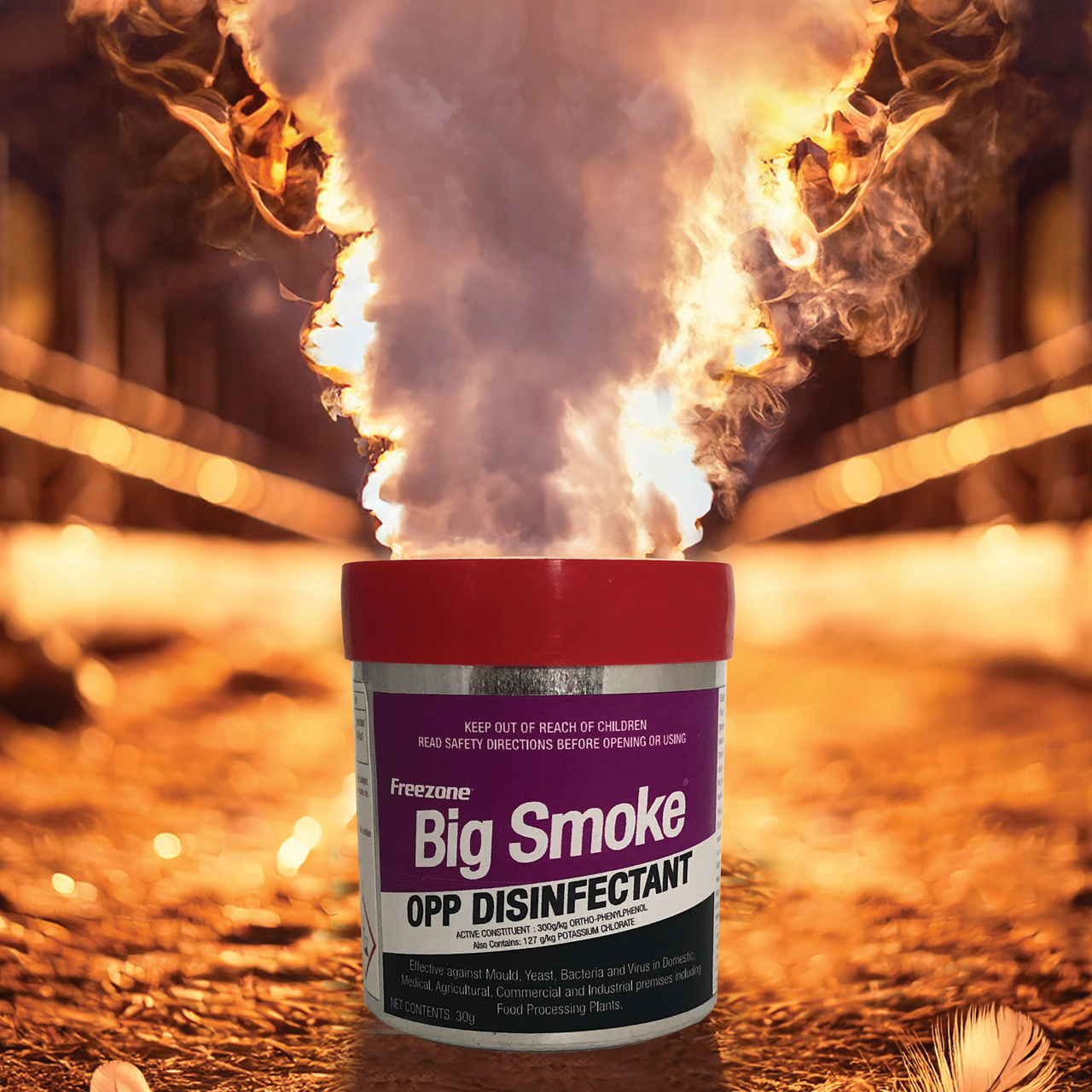


- One 30g tin treats up to 30m³ — a coop, feed shed or garage in one go
- Dry disinfectant smoke settles on every surface — including the cracks, corners and roof space a spray can't reach
- On the maker's EN-standard testing: effective against Avian Influenza A virus, Newcastle disease virus, E. coli, Staph, moulds and more
- No mixing, no water, no equipment — open the tin, light the wick, walk away
- Plan it around one night — the chooks sleep elsewhere the night you light it, back on the roost the next evening
- The second step of a proper coop clean-out — after the scrub and spray
- One tin = 30m³ — coop, feed shed or garage
- Smoke reaches where sprays can't — cracks, voids, roof space
- Plan for one night — birds back 24–48h after lighting
The clean a spray bottle can’t do
Scrub and spray a coop and you’ve disinfected the surfaces you can see and reach. But disease doesn’t only live where the cloth goes — it sits in the cracks between boards, behind nesting boxes, up in the roof space, in the corners of the feed shed.
Big Smoke OPP is a disinfectant that travels as a dry smoke. Light the wick and the active rises in a column, spreads through the whole airspace, then settles as it cools — onto every surface in the room, including the ones you can’t touch. It’s how commercial poultry sheds and hatcheries finish a clean-out, in a tin sized for a backyard coop.
What it’s tested against
On Freezone’s EN-standard efficacy testing, Big Smoke OPP is effective against bacteria, moulds, yeasts and viruses, including:
| Group | Tested organisms include |
|---|---|
| Viruses | Avian Influenza A virus, Newcastle disease virus, Adenovirus, Norovirus (murine), Coronavirus 229E |
| Bacteria | E. coli, Staphylococcus aureus, Enterococcus, Pseudomonas |
| Moulds & yeasts | Aspergillus (the feed-shed mould), Candida |
Straight answer on bird flu
No product can promise to keep bird flu out of a flock, and we won’t pretend otherwise. The official advice to keepers has two halves: keep wild birds away from your flock’s feed and water, and keep the coop and equipment clean. Big Smoke OPP does the second half properly — and its tested list includes Avian Influenza A and Newcastle disease virus.
How it works — three steps
- 1. Empty the space. Birds and pets out, feeders and drinkers can stay in place after their own clean. Close windows and openings.
- 2. Sit the tin on something non-combustible — a brick, paver or tile — and light the wick. Never stand it inside a bucket, pail or any other container: the smoke needs to rise freely, and heat needs somewhere to go. The burn starts slowly — controlled and non-pyrotechnic — giving you time to walk out and shut the door.
- 3. Leave it closed overnight — 15 hours is the optimal contact time. Air the space well before the birds go back in. Bin the cooled tin with your normal rubbish once fully spent.
Plan it around one night — whatever your flock size
The maker’s directions are 24–48 hours between lighting the tin and the birds going back in — so the flock sleeps somewhere else that night, and the plan depends on your numbers. A handful of chooks: a pet carrier or a dog crate in the garage (chickens move easily after dark). A dozen or twenty: a secure run with a temporary roost for the night. A chicken tractor or mobile chicken coop with a big flock: do one house at a time — move the birds into the next unit for the night, smoke the empty one, then bring it back into use the following evening.
Whatever the size, decide where the birds will sleep before you light the tin — and with H5 about, that’s a plan worth working out well ahead of time, not on the day. Light in the evening, open the coop the next morning, air it through the day; they’re back on the roost the following evening.
The two-step clean-out
This is the same sequence commercial sheds use, sized for a backyard:
- Step 1 — clean and spray. Bedding out, surfaces scrubbed, then a spray disinfectant like Virkon S over surfaces, feeders, drinkers and water lines.
- Step 2 — fumigate. Bedding and equipment back in place, then one Big Smoke tin finishes the job — treating the air, the fresh litter and every surface at once, 24–48 hours before the birds return.
Step by step, both halves: cleaning the coop and disinfecting it once it’s clean.
Which spaces, how many tins
| Space | Tins |
|---|---|
| Backyard coop or walk-in run (up to 30m³) | 1 × 30g |
| Feed shed or single garage | 1 × 30g |
| Coop + feed shed (the usual pair) | 2 × 30g |
| Large shed, stable or kennel block (up to 200m³) | 1 × 200g |
A 30g tin carries 9g of active (ortho-phenylphenol, 30%) — pre-dosed for even dispersion, so there’s no measuring and no way to over- or under-mix.
Using it safely
- Empty space only — birds, pets and people out until it’s been aired
- Don’t breathe the smoke — light it and leave; gloves when handling the tin
- Sit the tin on a brick, paver or tile — never on bedding or timber, and never inside a bucket or pail
- Keep tins away from ponds, fish tanks and waterways — the active is toxic to aquatic life
- Store in the original tin, out of reach of children; 2-year shelf life unopened
Always read the label and follow the directions for use. Australia-only delivery.
Goes with
- Virkon S Disinfectant 50g — the spray half of the clean-out
- Rat Baiting Kit — if the shed problem is vermin, not germs
- Dine-A-Chook Large Feeder — keeps feed off the ground and wild birds out of it
Frequently Asked Questions
Smoke vs spray, timing, safety around the flock — the questions we get on the phone.
What does a disinfectant smoke do that a spray doesn’t?
A spray disinfects what you point it at. Smoke fills the whole airspace and then settles on every surface as it cools — the cracks between boards, behind the nesting boxes, the roof space, the corners you can’t reach with a cloth. The two work together: spray the surfaces you can reach, smoke the space as the finishing step.
Can my chickens be in the coop while it works?
No. Big Smoke is for empty spaces only — birds, pets and people stay out from the moment you light it until you’ve aired the coop properly afterwards. The usual pattern is to light it in the evening after a clean-out, leave it shut overnight, then air it out well. Have the birds back 24–48 hours after treatment.
Where do the chickens sleep while it works?
Somewhere secure for one night — that’s the whole disruption, and the plan depends on your numbers. A handful of chooks: a pet carrier or a dog crate in the garage (chickens move easily after dark). A dozen or twenty: a secure run with a temporary roost for the night. A chicken tractor or mobile chicken coop with a big flock: do one house at a time — move the birds into the next unit for the night, smoke the empty one, then bring it back into use the following evening. Whatever the size, decide where the birds will sleep before you light the tin — and with H5 about, that’s a plan worth working out well ahead of time. The pattern: settle the flock for the night, light the tin in the evening, open the coop the next morning and let it air through the day. They’re back on the roost the following evening — 24–48 hours after lighting, as the maker directs. What you can’t do is smoke the coop and put the birds back in the same night.
How long does it take?
The tin itself burns down in minutes and does its spreading in the first hour. The full effect comes from contact time: leave the space closed for about 15 hours, then open it up and air it before anyone — feathered or otherwise — goes back in.
Does it help against bird flu?
No single product can promise to keep bird flu out of a flock, and we won’t pretend otherwise. What we can tell you: on the maker’s EN-standard testing, Big Smoke OPP is effective against Avian Influenza A virus and Newcastle disease virus, and it covers the “keep it clean” half of the official advice. The other half is keeping wild birds away from your flock’s feed and water.
Will it deal with red mite, lice or rodents?
No — and we’d rather tell you straight than sell you the wrong tin. Big Smoke OPP is a disinfectant: it works on bacteria, viruses, moulds and yeasts. It is not an insecticide or a rodenticide. For rats, see our Rat Baiting Kit; for mites and lice, start with our parasite guides in the Chook School.
Does it leave a residue or damage anything?
It’s a dry treatment — no water, no wet fog, no corrosion risk, and a low residue level. That’s one of the reasons this method is used around machinery, electrics and equipment that shouldn’t get wet. Feeders and drinkers can stay in the coop during fumigation after their own clean.
How many tins do I need?
One 30g tin treats up to 30 cubic metres — more than most backyard coops, walk-in runs, feed sheds or single garages. Treat each enclosed space with its own tin; the usual backyard pair is one for the coop and one for the feed shed. For a big shed, stable or kennel block, that’s the 200g tin’s job.
Can I use it inside the house or shed?
Yes — the label covers domestic, agricultural, commercial and industrial premises. Same rules as the coop: empty room, closed up for the contact time, aired well afterwards. It’s commonly used for musty and mould-affected spaces — Aspergillus is on the tested list.
Is it safe to have around the property?
Treat it with the same respect as any farm chemical: store it in the original tin out of reach of children, wear gloves when handling, never breathe the smoke, and keep it away from ponds, fish tanks and waterways — the active is toxic to aquatic life. When lighting, sit the tin on something non-combustible like a brick, paver or tile — never on bedding or timber, and never inside a bucket or pail; the smoke needs to rise freely. Always read the label and follow the directions for use.
Do you deliver Australia-wide?
Yes — Australia-only delivery, sent by road service. Like our bait products, it cannot be sent overseas.
Not sure if a smoke or a spray is the right tool for your job? Get in touch — it’s the advice we give every week on the phone, and we’re happy to give it.