



- No egg withholding period — keep collecting and eating eggs right through the 7 days
- The only wormer we stock that treats tapeworm, at its higher rate
- Also roundworm, caecal worm and hairworm (threadworm)
- A powder you mix into feed — nothing to persuade them to drink
- Active constituent 50 mg/g flubendazole. Australian made
- Meat birds: remove medicated feed 7 days before slaughter
- No egg withholding period
- Treats tapeworm, plus roundworm, caecal and hairworm
- Mixes into feed, 7 days straight
- 50 mg/g flubendazole, Australian made
- Meat birds: 7 days before slaughter
Keep eating the eggs
Most wormers come with a catch: bin your eggs for days afterwards. For anyone who actually eats what their hens produce, that is not a small inconvenience — it is the reason worming gets put off, sometimes far too long.
Fluverm's egg withholding period is nil. You treat the flock and carry on collecting and eating the eggs the whole way through, and straight afterwards. Nothing gets thrown out, so routine worming becomes something you actually do rather than something you keep meaning to.
The one that covers tapeworm
This is the real difference between Fluverm and a levamisole wormer. Tapeworm is on the Fluverm label, at a doubled rate. It is not on Kilverm's.
| Large roundworm | Ascaridia galli — the most common intestinal worm in chickens |
|---|---|
| Caecal worm | Heterakis gallinarum — lives in the caeca |
| Hairworm / threadworm | Capillaria spp. — the thin threads sometimes seen in egg white |
| Tapeworm | Raillietina spp. — needs the doubled rate below |
Fluverm does not treat gapeworm (Syngamus trachea), which lives in the windpipe rather than the gut. Coughing, neck-stretching, head-shaking or gasping is not an intestinal worm — speak to a vet, because it is easily confused with respiratory disease.
How much, and for how long
Fluverm is a powder that goes into the feed at 600g per tonne — which is 0.6g per kilogram of feed — for 7 consecutive days. For tapeworm, double it to 1200g per tonne, still for 7 days.
| Feed | Fluverm | For tapeworm |
|---|---|---|
| 1 kg | 0.6 g | 1.2 g |
| A Dine-A-Chook Small Feeder, 2.6 kg | 1.6 g | 3.1 g |
| A Dine-A-Chook Large Feeder, 3.7 kg | 2.2 g | 4.4 g |
| The included 13 g scoop | just over 21 kg of feed | just under 11 kg |
Make it the only feed
Mix it through thoroughly so every mouthful carries the dose, and make the treated feed the only food for the full seven days — no scraps, no treats. A bird topping itself up elsewhere is a bird getting a part dose.
What a tub actually costs to use
The tub treats a full tonne of feed, which is why it looks expensive next to a small bottle and is not. Six average hens get through roughly 5kg of feed in seven days, so a complete course uses about 3g.
That is around 35 cents a worming for a flock of six — and one tub holds far more courses than a backyard flock will ever need. Worth checking the expiry date on the tub and splitting it with someone if your flock is small.
Fluverm or Kilverm?
We stock both because they suit different situations.
| Fluverm | Kilverm | |
|---|---|---|
| Goes into | Feed | Drinking water |
| Treatment | 7 days straight | One morning, repeated in 2 weeks |
| Tapeworm | Yes, at the doubled rate | No |
| Gapeworm | No | No |
| Egg withholding | Nil | Nil |
| Clear of slaughter | About 14 days — 7 days of treatment, then 7 days off the medicated feed | About 8 days — one day's dosing, then 7 days |
| Hot weather | No restriction on the label | Not in extremely hot weather |
So: tapeworm, or you would rather not fight them over medicated water — Fluverm. Meat birds close to processing, or a heatwave is not due — Kilverm clears in about eight days against Fluverm's fourteen, because Fluverm's seven-day course has to finish before its withholding period even starts. Some keepers alternate the two to reduce the chance of resistance building. Our full comparison goes through it properly.
Before you use it
Not for pigeons or parrots
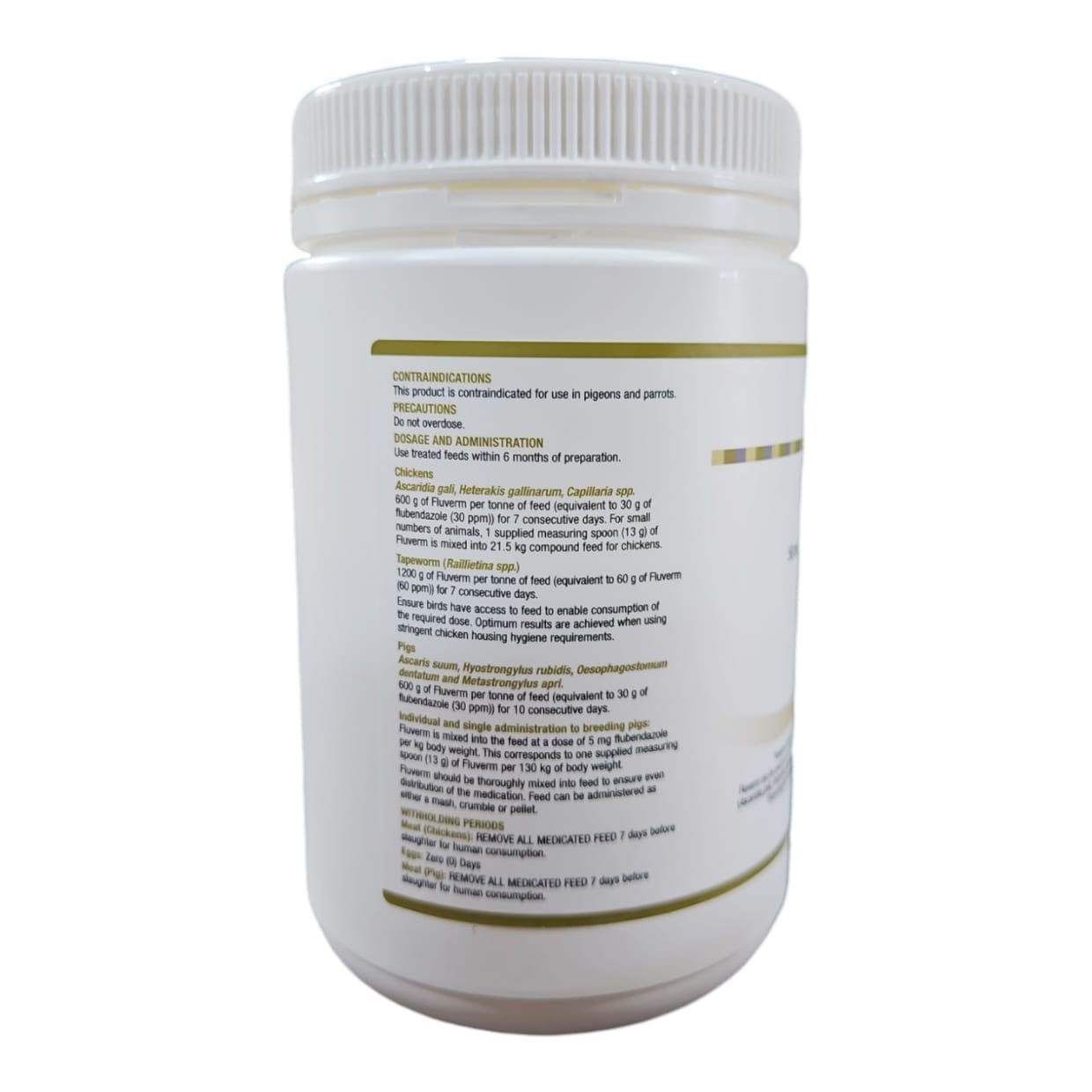
The label states Fluverm is contraindicated in pigeons and parrots. It is registered for chickens and for pigs, and nothing else.
- Eggs: no withholding period. Keep collecting and eating them throughout.
- Meat birds: remove all medicated feed 7 days before slaughter for human consumption. Since the course itself runs 7 days, allow about a fortnight from starting treatment.
- Mix it thoroughly, and treat for the full 7 consecutive days rather than stopping when the birds look better.
- Store below 30°C in a cool, dry place, and check the expiry date on the tub.
- Always read the label and follow the directions for use.
When to worm
- Routinely, every six months, whether or not anything looks wrong. Free-range birds working the same ground all year pick up more and may need it more often.
- Before new birds join the flock, rather than after.
- If you see the signs — weight loss, a pale comb, dropping off in lay, threads in the egg white, or worms in the droppings.
A healthy chicken carries a few worms without any sign of it. The goal is keeping the load down, not sterilising the bird.
Also registered for pigs
Fluverm covers gastrointestinal worms and lungworm in pigs at 600g per tonne of feed for 10 consecutive days, with the same 7-day meat withholding. The rates are on the label.
Worth having alongside it
A worm burden takes a toll even once it is dealt with, and birds coming out of a heavy load benefit from a hand back up.
| Mega Mineral 50ml | Chelated trace minerals, a few drops in the drinker. Supports condition after worming |
|---|---|
| Kilverm 125ml | The water-based wormer, for alternating between the two or for ducks and turkeys |
| A covered feeder | Medicated feed only works if the birds eat it and the weather does not. Keeps the dose dry for the full seven days |
Specifications
| Size | 600 g tub, with a 13 g scoop |
|---|---|
| Active constituent | 50 mg/g flubendazole |
| Controls | Large roundworm, caecal worm, hairworm, tapeworm |
| Rate | 600 g per tonne of feed (0.6 g/kg), 7 consecutive days — 1200 g per tonne for tapeworm |
| Egg withholding | Nil |
| Meat withholding | Remove all medicated feed 7 days before slaughter |
| Not for | Pigeons or parrots |
| Also registered for | Pigs (see label for rates) |
| APVMA registration | 93835 |
| Manufacturer | Vetsense — made in Australia |
Always read the label and follow the directions for use. If you are worried about a bird, speak to a vet. For more on keeping a flock healthy, visit our Chook School.
Worm the flock. Keep the eggs.
600g tub with a 13g scoop, Australian made, and enough in it to last a backyard flock for years. Not sure which wormer suits your birds? Ring us on 1800 103 326 — you will get a person.
Product Specifications
Frequently Asked Questions
Dosing, timing and the questions we actually get asked about worming with Fluverm.
Can I really eat the eggs during treatment?
Yes — the egg withholding period is nil. Collect and eat them right through the seven days and straight afterwards. Nothing needs setting aside, which is the main reason people choose Fluverm.
How much do I use?
0.6g per kilogram of feed — that is the label's 600g per tonne — every day for 7 consecutive days. A Dine-A-Chook Small Feeder holds 2.6kg, so 1.6g a refill; the Large holds 3.7kg, so 2.2g. The included 13g scoop covers just over 21kg of feed. Mix it right through so every mouthful carries the dose.
How do I treat tapeworm?
Double the rate — 1.2g per kilogram of feed (1200g per tonne), still for 7 consecutive days. That works out at 3.1g for a Small Feeder refill and 4.4g for a Large. Tapeworm is the one thing Fluverm covers that a levamisole wormer like Kilverm does not.
What about meat birds?
The label says remove all medicated feed 7 days before slaughter for human consumption. Because the course itself runs seven days, allow about a fortnight from the day you start. If birds are closer to processing than that, Kilverm is the quicker option — one morning's dosing plus its own 7-day withholding, so roughly eight days end to end.
Can I use it on ducks, turkeys or other birds?
No. Fluverm is registered for chickens and pigs, and the label specifically states it is contraindicated in pigeons and parrots. If you need to worm ducks, turkeys or other poultry, Kilverm's label covers domestic fowl, turkeys and other birds — that is the one to reach for.
Does it treat gapeworm?
No. Gapeworm (Syngamus trachea) lives in the windpipe rather than the gut and is not on the label. Coughing, head-shaking, neck-stretching or gasping is not an intestinal worm — that is one for a vet, and it is easily confused with respiratory disease. Worth knowing Kilverm does not treat gapeworm either.
What if they will not eat the treated feed?
It is a fine powder and mixes in without changing the feed much, so this is rarely the problem it is with a bitter liquid wormer. What does cause trouble is other food: make the treated feed the only food for the full seven days — no scraps, no treats, and keep them off the compost heap. A bird topping up elsewhere is a bird getting a part dose. A little vegetable oil through the feed helps the powder stick if it is settling out.
Is seven days enough? Should I treat for longer?
Seven consecutive days is the full course on the label — do not extend it beyond that unless a vet tells you to. What matters far more is not stopping early. Birds often look better after two or three days; the worms that survive are the reason you finish the week.
How does it compare with Kilverm?
They suit different situations. Fluverm is a powder in the feed, covers tapeworm, and runs seven days. Kilverm is a liquid in the drinking water, is done in one morning with a repeat a fortnight later, covers other poultry species, and clears meat birds faster. Both have no egg withholding period, and gapeworm is not on either label. Some keepers alternate them to reduce the chance of resistance building. We stock both.
How often should I worm?
Every six months as a routine, plus any time new birds are about to join the flock. Birds that free range over the same ground all year pick up a heavier burden and may need it more often. With no egg withholding period there is nothing to plan around.
How long will one tub last?
Far longer than most people expect. The 600g tub treats a full tonne of feed. Six average hens eat roughly 5kg over a seven-day course, so one complete worming uses about 3g — around 35 cents' worth. For a backyard flock that is effectively a lifetime supply, so check the expiry date on the tub, and it is worth splitting with someone if your flock is small.
Can I worm young birds?
The label does not set a minimum age, and because Fluverm goes into feed the bird needs to be eating solid feed properly for the dose to be reliable. Mix it very thoroughly for young birds on crumble. If you are unsure, or a bird is unwell, ask your vet first.
I can see worms in the droppings after treating. Is that bad?
No, that is the treatment doing its job — the worms are being passed. Keep going for the full seven days, and clean the coop and run out thoroughly afterwards, or the birds pick the parasite straight back up off the ground.
Not sure which wormer you need, or how much for your flock? Get in touch — we are a small Australian family business and we answer our own emails.